Complaint Process
DMC COMPLAINTS HANDLING PROCESS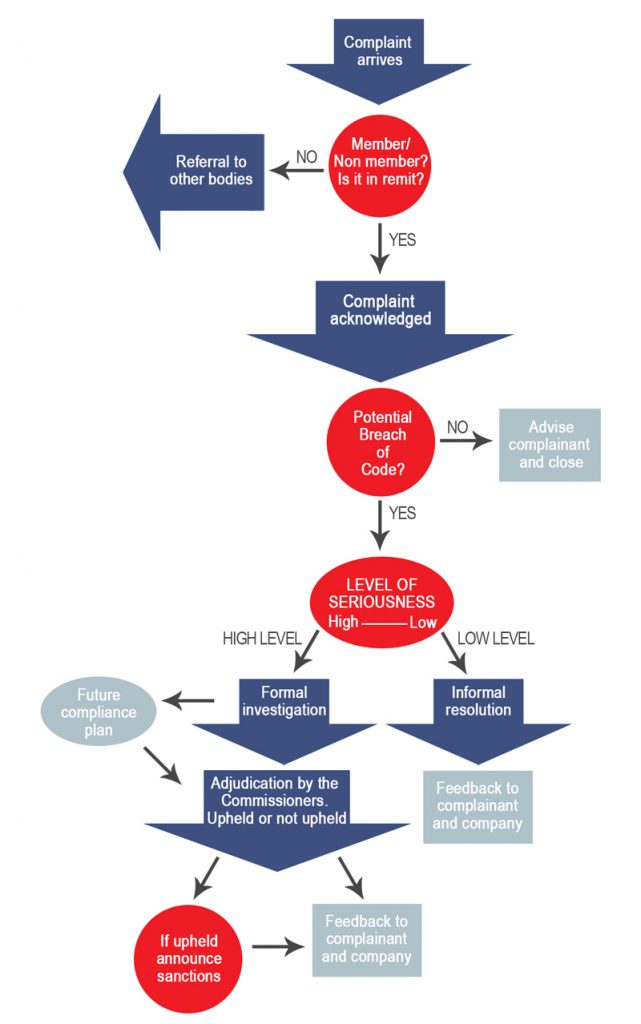
The DMC investigates complaints against DMA members involving breaches of the DMA Code and any investigation and adjudication is based solely on compliance with the DMA Code.
Complaints considered
The DMC will investigate any complaint made against a DMA member that relates to data & marketing activity and falls under the scope of the Code.
A complaint can either be received directly or referred from the DMA or from a statutory, advisory, self regulatory or enforcement body.
The DMC can also open an investigation on its own initiative if it sees an issue, involving a member company.
The DMC will investigate a complaint against a non-DMA member if the Code is binding on that party by any regulatory, licensing or other condition.
Complaints not considered
Where a complaint is of a contractual nature and does not involve a serious breach of the Code that would affect other parties, then the disputing parties may be advised to use an alternative mechanism to reach resolution.
If a complaint is not covered by the Code, or involves a company not in DMA membership, it will be referred to another relevant organisation or enforcement body.
The DMC may look at and express a view on the conduct of non-members in exceptional circumstances, where this is in the best interests of customers and members in the marketplace, but will not seek to enforce the Code or the procedures set out here.
More information about the complaints process: www.dmcommission.com/make-a-complaint/.
Receipt of complaints
A complaint can be made in writing or online at www.dmcommission.com/make-a-complaint/complaints-form/
The DMC aims to acknowledge a complaint within two working days and to complete a case involving investigation and adjudication within three months, but expects an informally-resolved case to be closed in a shorter timeframe.
The DMC can only act on a complaint if there is enough information to identify that there is an issue in relation to the Code and a party over which the DMC has jurisdiction.
A complaint should be accompanied by all available supporting material, such as correspondence or a copy of the relevant commercial communication.
Gathering evidence
Upon receipt of a complaint, the Secretariat will raise the matter directly with the member. The member must respond to this request within 10 working days of receipt.
If the member fails to respond to any request for information from the Secretariat, this may in itself constitute a breach of the Code and result in disciplinary action.
The Secretariat may also request that the member responds directly to the complainant, with a copy of any response sent to the DMC.
The DMC may ask the DMA to compile additional information to inform investigation into any complaints.
Investigation process
The DMC exercises judgment in deciding whether a complaint or a number of related complaints appear to require a substantive investigation and a formal adjudication or whether the matter can be resolved informally.
It is the responsibility of the DMC, and the Chief Commissioner in particular, to ensure complaints are treated in a proportionate and appropriate manner.
Informal resolution
Where there appears to have been a minor breach of the Code and where there is no evidence of wider harm or risk, the Secretariat may close the matter with a formal reminder of the member’s obligations under the Code.
Where a complaint can be answered by the Secretariat without reference to the member, a copy of any correspondence will be sent to the member for information.
In a case where an informal resolution is being considered, the DMC retains the right to revert to a formal investigation in the light of evidence of more serious or widespread harm.
If a complaint is not resolved to the satisfaction of the DMC, or it appears that there is a serious or ongoing breach of the Code, it will be referred to the DMC Board for consideration and possible adjudication under the provisions of the Code.
Formal investigation
If a complaint is referred to the DMC Board, the Secretary will inform the member and request any information or comment. Members must respond to the request within 10 working days.
The Secretariat may revert to the member, either through meetings or correspondence, if this is necessary to bring together the information needed to reach an informed adjudication.
The Secretariat will then submit a report to the DMC, including any material that either party has specifically requested be brought to attention.
The DMC Board will then consider the complaint, requesting any further information as necessary.
The DMC may invite the member to meet with them in advance of their deliberations if it is thought that it would be helpful for the member to explain their business model and the events in question informally.
In the case of a formal investigation, member representations may be made as part of the evidence-gathering process and just prior to adjudication.
Adjudication meetings generally involve only Commissioners and the Secretariat.
The Secretariat may end a formal investigation during the process and close the case, or reach an informal resolution if it becomes clear the case did not merit a substantive process and formal adjudication.
The decision of the DMC will be recorded and communicated in writing to the member company.
A summary of the adjudication is placed on the DMC website as soon as possible in all cases following a formal investigation, whether or not breaches have been upheld. A summary is NOT posted if the DMC declines to adjudicate on the grounds that there is no case to answer.
The DMC may refer a case back to the Secretariat with a request that the Secretariat look further at resolving the matter though informal procedures.
More information about adjudications: www.dmcommission.com/adjudications.
DISREPUTE
The DMA Code asks that “members must ensure that they do nothing that could bring into disrepute the public image of one-to-one marketing or the DMA”. The DMC will apply this rule in exceptional circumstances where it is clear that there is “intent” and where the behaviour is abnormal to the industry.
THE DATA JOURNEY
A data journey is the path travelled by a consumer’s data throughout its use. A data journey may have a number of steps and will vary from case to case. Visualising the data journey allows us to see how data has moved from one step to another. We can signpost different clauses or possible breaches at each step identifying problems.
CRITERIA FOR JUDGEMENT
All complaints to the Secretariat are reported to the DMC in a monthly breakdown report.
Those cases that the Secretariat consider should be ‘formally investigated’ (that is, to undergo a formal process of investigation and adjudication) are presented with relevant paperwork to the DMC for adjudication.
‘Informally resolved’ complaints are investigated and resolved to the satisfaction of the Secretariat of the DMC with no further action deemed necessary.
If Commissioners require information on any complaint or if they deem any cases to be more appropriate for adjudication (ie ‘formally investigated’), then they inform the Secretariat as soon as possible so that a formal process can be undertaken. The Secretariat may encourage a member company, within the timescales of a formal investigation, to prepare a future compliance plan detailing any relevant changes of practice. If a plan and timeframe is agreed, this will help inform the Commissioners’ decisions at the adjudication stage.
Complaints ‘informally resolved’ by the Secretariat may include:
a. minor customer service issues eg non-receipt of goods, unsolicited goods, faulty goods, poor quality goods, delivery or collection problems, poor advice/customer service; account errors.
b. consumer misinterpretation or misunderstanding of their own or the company’s obligation.
c. minor data issues eg unwanted emails, unwanted mail, incorrect personal details, technical problems – issues that are not regularly reported against one specific company or do not affect large numbers of consumers.
d. business to business cases where there is no easily identifiable breach (for example, contractual disputes) – alternative dispute resolution mechanisms may be advised.
If there is a minor breach of the Code then a ‘reminder of obligation’ may be issued which serves as a reminder to the company of their obligations under the code. These reminders are made in particular to those companies who do not appear sufficiently aware of the Code’s requirements or if it is not clear as to whether or not there has been a breach.
Complaints ‘formally investigated’ ie adjudicated by the DMC may include:
a. serious breaches of the Code which might result in damaging the public image of direct marketing: serious breaches of legislation; mis-selling of goods; misleading marketing material.
b. repeated complaints against one company which indicates a particular concern eg inefficient customer service, poor data processing, silent calls, difficulty unsubscribing from emails, unwanted mail. Or the company may simply be experiencing an increasing level of complaints. Not every ‘individual complaint’ that shows evidence of a Code breach is necessarily upheld; any number of complaints can be upheld at one time.
c. minor breaches of the Code which may affect large numbers of consumers eg wording used in marketing material which has been misconstrued. Even if there is only one complaint, many consumers who do not complain could be affected.
d. cases where the company fails to respond to the Secretariat.
Please see below for Quickcheck Flowchart.
https://www.dmcommission.com/wp-content/uploads/2018/09/DMC-Quickcheck-Flowchart.ppt
Detail of Complaint Process
a. Complaint received via telephone, email or post. All complaints must be made in writing with relevant correspondence and evidence. The DMC cannot become involved in matters of financial compensation.
b. The Secretariat acknowledges receipt of the complaint via email or letter within two days. The Secretariat informs the complainant that the member company may write to them directly with a response to their complaint, but that the Secretariat themselves will also need to be assured that the complaint is resolved to the DMC’s satisfaction. Any further details required from the complainant must be received within ten working days.
c. A letter/email is sent to the company with a copy of the complainant’s correspondence. The Secretariat seeks a response within ten working days in accordance with the Code. The Secretariat may ask the company to write directly to the complainant with a copy to DMC. If the Secretariat does not receive a response within ten working days a reminder is issued. Companies are informed that under the Code a response is expected within this timescale. Some lenience may be given if a detailed investigation has to be undertaken by the company or the primary contacts are away. Not responding to a request from the Secretariat is in breach of the Code.
d. Details of the complaint are input on to the database. The Secretariat inputs the name, address details and a summary of the complaint.
[* Business to Business Complaints: In the case of business to business complaints the Secretariat would not generally ask the company to write directly to the complainant – material from both parties is collected]
e. When the company’s response is received the Secretariat sends a letter/email to the complainant. If the Secretariat finds it satisfactory, a copy is sent with a covering letter to the consumer; the Secretariat will also ask the consumer to make further contact with the DMC if they have any concerns. Depending on the nature of the complaint further information will be offered as to any action that may be taken.
f. Letter/email to company from the Secretariat. The Secretariat does not necessarily respond again to the company in question, but if there is a minor breach of the Code then a ’reminder of obligation’ may be issued which serves as a reminder to the company of their obligations under the Code. These reminders are made in particular to those companies who do not appear sufficiently aware of the Code’s requirements or in some cases, where it is unclear whether or not there has been a breach. The Secretariat will ask for the company’s assurance that the Code will be adhered to in future.
g. Details of the direct marketer’s response input on to the database. The Secretariat inputs details of the company’s response/‘reminder of obligation’ if required/whether the complaint has been upheld or not upheld (if the case has been presented for adjudication by the Board of the DMC).
Formal Investigations
The Secretariat will write to the company, informing them that the case is to be adjudicated formally by the DMC and that they have ten working days to add any further information to the casework. During the course of our enquiries we may contact third parties and we may ask them for complaint or other information that has relevance to an investigation. We aim to disclose information gathered where appropriate and where this is permissable.
Following the DMC’s adjudication, letters are sent by post to the complainant and to the company in question stating whether or not the complaint has been upheld. If the complaint is upheld, the company may be asked to provide a written undertaking that they will, in future, comply with the Code. Other sanctions may be imposed depending on the nature of the complaint. The Secretariat aim to achieve final adjudication within three months.
Production of monthly reports
A ‘Monthly Report’ of activities is sent to Commissioners at the start of each month alongside a breakdown of monthly complaints.
Publishing Complaints
All formally investigated complaints are placed on the DMC website, comprising a short description of the case and the relevant Code requirement together with the outcome of the investigation. A synopsis of complaints informally resolved by the Secretariat is updated regularly on the website. The Annual Report contains examples of cases to give direct marketers, the public and others an outline of the DMC’s work and how companies achieve compliance with the DMA Code.
